
Introduction
The ability to communicate effectively in English plays an important role in academic, professional, and social contexts (Yu et al., 2019). However, in many English as a Foreign Language (EFL) learning settings, students continue to struggle with oral communication due to grammar-based instruction and limited opportunities to speak. Classroom anxiety, minimal fluency, low real-life communicative needs, and the lack of contextualization in speaking tasks contribute to the persistent gap between learners’ receptive and productive skills (Alazeer & Ahmed, 2023; Chand, 2021; Okyar, 2023; Suparlan, 2021). These realities highlight the need for pedagogical interventions that address both cognitive and affective barriers to speaking.
Speaking difficulties remain evident across international contexts. Learners may achieve strong grammatical knowledge and reading proficiency yet still struggle to become fluent speakers. In Japan and South Korea, cultural norms and limited conversational habits have hindered learners’ confidence and fluency development (Baek & Lee, 2021; Darasawang & Reinders, 2021). In the Middle East and Latin America, overcrowded classrooms and ineffective teaching methods have been identified as barriers to the development of oral communication (Alweldi et al., 2024). In Rwanda, limited exposure to English-speaking environments has constrained vocabulary development and speech production (Ndayisaba et al., 2024). These global challenges emphasize that speaking proficiency requires targeted instructional support, not only exposure to grammar and reading instruction.
In the Philippine context, competence in spoken English remains a persistent concern. Although Filipino learners often demonstrate stronger performance in reading and listening, speaking proficiency continues to lag behind due to teacher-centered instruction and limited opportunities for meaningful oral practice (Chand, 2021). This concern is further intensified in many public school settings, where large classes and the lack of sustained communication training may weaken learners’ confidence and willingness to participate in oral tasks (Tarrayo et al., 2022). Moreover, speaking proficiency is not automatically developed even among learners preparing for academic and professional communication demands, particularly when structured support and purposeful oral practice are insufficient (Dinçer & Dariyemez, 2020). Addressing this gap requires deliberate pedagogical strategies and ongoing teacher development to promote interactive, communicative, and learner-centered speaking instruction (Al-Wadi, 2023).
English proficiency is multidimensional, encompassing fluency, accuracy, vocabulary, and confidence, all of which are essential for academic participation and daily communication (Yu et al., 2019). However, as shown in both international and local literature, speaking proficiency remains underdeveloped because learners experience limited speaking opportunities and insufficient structured guidance (Chand, 2021; Tarrayo et al., 2022). This persistent mismatch between receptive language competence and oral production suggests that students require structured models that guide the organization of ideas, support language formulation, and encourage participation.
In response to these challenges, structured speaking frameworks have been introduced as classroom interventions to scaffold oral production. One model is the PREP (Point–Reason–Example–Point) Framework, which is designed to promote clarity, logical sequencing, and expanded idea development. PREP supports learners by scaffolding information and organizing ideas, which may reduce anxiety and improve fluency during speaking tasks (Saad et al., 2023; Zhou & Feng, 2021). PREP also functions as a structured discourse tool that enhances coherence and persuasive effectiveness, making it suitable for academic and professional communication tasks (Zhou & Feng, 2021). Moreover, when integrated into mobile-assisted or blended learning environments, PREP-based speaking tasks can provide learners with continuous feedback and sustained practice opportunities that support speaking development (Elsani et al., 2023; Wen, 2023).
Another structured model commonly used in classroom speaking instruction is the Conventional Approach, often presented as the Introduction–Body–Conclusion (IBC) format. This model supports speaking development by providing learners with a clear and sequential structure for expressing ideas and sustaining longer discourse. Structured activities such as drama and dialogue-based tasks have been shown to enhance engagement and promote practical speaking competence through meaningful communication practice (Alasmari & Alshae’el, 2020). Similarly, the structured nature of the conventional approach supports learners’ confidence and oral organization by guiding them in building responses within conversational classroom environments (Ngo & Ha, 2022).
Although both models offer structured support for speaking development, comparative evidence remains limited in Philippine public school settings, especially among junior high school learners. This gap is critical because speaking problems in these contexts are often associated with limited use of English in the classroom, a heavy emphasis on written activities, and speaking anxiety (Tarrayo et al., 2022). Without clear comparative findings, teachers may struggle to identify which structured model better supports micro-linguistic improvement (fluency, pronunciation, and grammar accuracy) and macro-level discourse organization within real classroom constraints.
In response to this gap, the present study examined the effectiveness of the PREP Framework and the Conventional Approach in improving the English-speaking proficiency of Grade 9 students in a public secondary school in El Salvador City. The study evaluated learners’ speaking proficiency across key dimensions and compared the outcomes of the two interventions. The study contributes to the growing discussion on how structured speaking models can strengthen learners’ communicative competence in EFL classrooms.
As illustrated graphically in the diagram (Figure 1), the independent variables (PREP and CONVENTIONAL approach models) are assumed to have effects on three and main dimensions of English speech performance through learner engagement, diminished anxiety, and increased exposure to structured speaking occasions
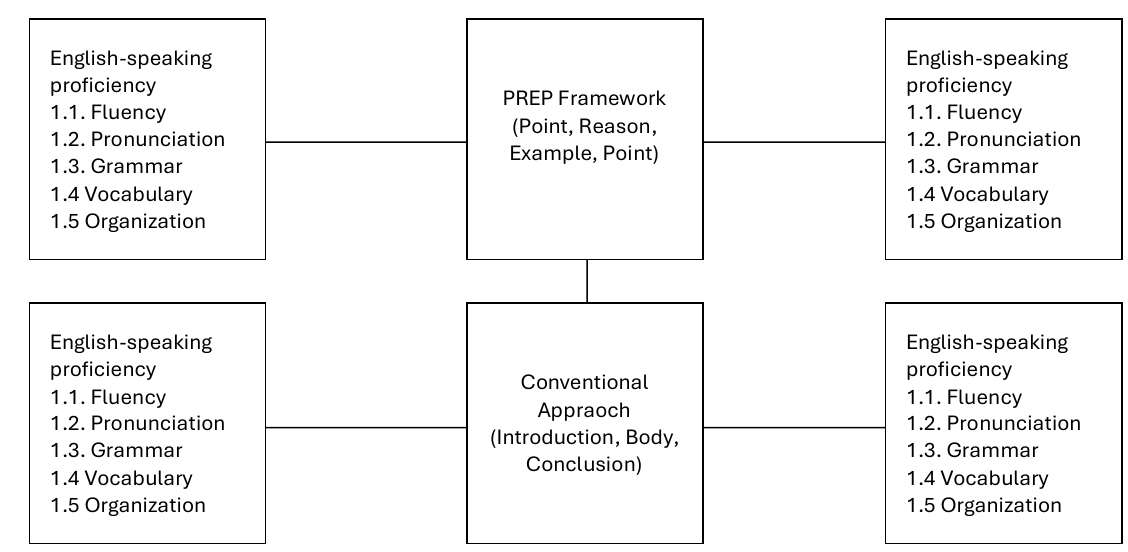
The research seeks to ascertain the effectiveness of PREP (Point-Reason-Example-Point) and Conventional (Introduction-Body-Conclusion) pedagogical techniques in developing communicative competence among Junior high school students at a public school in El Salvador City. Specifically, the study seeks to answer questions that follow:
- What are the English-speaking proficiency levels of the two groups of students before and after the intervention, along the following dimensions: 1.1. Fluency; 1.2. Pronunciation; 1.3. Grammar; 1.4 Vocabulary; and 1.5 Organization?
- Is there a significant difference in the pretest and posttest results of students exposed to each intervention?
- Which among the two interventions is more effective in improving the participants’ English speaking proficiency?
Methods
This study used a quasi-experimental pretest–posttest non-equivalent groups design to evaluate the effectiveness of two structured speaking interventions—PREP (Point–Reason–Example–Point) and the Conventional Approach (Introduction–Body–Conclusion)—in improving Grade 9 students’ English-speaking proficiency. This design was selected because random assignment of individual students was not feasible in the natural classroom setting; however, comparing two instructional approaches under controlled classroom conditions remained necessary. The design allowed the study to (a) measure changes within each group from pretest to posttest and (b) examine comparative effects between groups, while accounting for baseline differences through statistical controls when appropriate. The intervention was anchored in Vygotsky’s Sociocultural Theory, emphasizing that learners develop higher communicative competence when supported through structured scaffolding and guided performance.
The participants were 86 Grade 9 students from a public secondary school in El Salvador City, Misamis Oriental, Philippines. Four intact classes were included: two were assigned to the PREP group and two to the Conventional group. Participants were aged 14–15 years, consistent with the typical junior high school population. Inclusion criteria included regular school attendance, absence of diagnosed speech or hearing disorders, and completion of required informed consent and assent forms. Students with prior formal training in speech, debate, or public speaking were excluded to minimize potential confounding influences on oral performance.
Students’ speaking proficiency was assessed using a researcher-developed analytic speaking rubric covering five dimensions: fluency, pronunciation, grammar accuracy, vocabulary use, and organization. The rubric used a five-point scale from Needs Improvement (1) to Outstanding (5). An analytic rubric was used because the study aimed to measure multiple components of speaking performance aligned with classroom speaking tasks, rather than focusing solely on fluency or speed-based speaking output. Compared with standardized fluency tests, the rubric enabled the researchers to capture a broader, more instruction-sensitive profile of students’ speaking proficiency (e.g., accuracy, vocabulary appropriateness, and organization), consistent with the objectives of classroom-based oral communication instruction.
Content validation was conducted through expert review by language specialists. To ensure scoring consistency, inter-rater reliability was assessed using Krippendorff’s Alpha, yielding α = 0.994, indicating excellent agreement between raters.
Ethical approval was secured from the institutional research ethics committee prior to implementation. Permission was obtained from the Schools Division Superintendent and the school principal. Participants and their guardians were informed about the study’s purpose, procedures, voluntary participation, confidentiality protections, and their right to withdraw at any time without academic consequences. All collected data were anonymized using participant codes.
A pretest was administered prior to the intervention, using an oral speaking task evaluated using a validated rubric. After the pretest, an eight-week intervention was implemented during regular English class sessions. Both groups received two structured speaking sessions per week, each lasting approximately 20–25 minutes, with comparable speaking time, topic difficulty, and classroom conditions. The researcher served as the intervention facilitator to ensure consistent delivery of instructions, pacing, and task sequencing across groups.
Students assigned to the PREP group were trained to deliver oral responses using a structured sequence:
- Point – state the main idea clearly in one sentence
- Reason – explain why the point is true or important
- Example – provide a concrete illustration, personal experience, or scenario
- Point (Restatement) – conclude by reinforcing the original claim
Each speaking session typically included: (a) teacher modeling of a PREP response, (b) guided practice using sentence starters, (c) pair or small-group rehearsal, (d) short individual speaking performance, and (e) brief corrective feedback focused on clarity, accuracy, and delivery.
Students assigned to the Conventional group practiced speaking using the Introduction–Body–Conclusion structure:
- Introduction – open the response and introduce the topic
- Body – provide supporting ideas, details, or explanations
- Conclusion – summarize the main idea and close the response
Sessions commonly included: (a) teacher demonstration of IBC organization, (b) outlining of ideas before speaking, (c) group sharing of main points, (d) short oral delivery, and (e) feedback emphasizing organization and completeness of ideas.
After the eight-week intervention, a posttest speaking task was administered using the same rubric and scoring procedures as the pretest. To reduce the possibility that improvement was attributable to familiarity with pretest prompts, the posttest used equivalent speaking tasks, matched in difficulty and format but not in wording. This ensured that gains reflected improved speaking proficiency rather than recall of the pretest content.
Descriptive statistics (means, standard deviations, and frequency distributions) were used to describe proficiency levels before and after the intervention. Inferential analyses were conducted to assess whether the observed changes were statistically significant. To examine whether each intervention produced improvement over time, a Repeated-Measures MANOVA (RM MANOVA) was conducted separately for the PREP and Conventional groups. This procedure was appropriate because the study measured multiple related speaking outcomes (fluency, pronunciation, grammar accuracy, vocabulary, and organization) across two time points (pretest and posttest). To determine which intervention was more effective, a MANCOVA was used to compare posttest performance between the PREP and Conventional groups, controlling for pretest scores. This method was necessary because the groups were non-equivalent at baseline, and intact classes were used; controlling for pretest scores helped reduce the influence of initial proficiency differences on posttest comparisons. All statistical tests used a significance level of α = 0.05, and effect sizes were interpreted using partial eta squared (η²).
Results
Table 1 presents the consolidated descriptive statistics for the PREP and Conventional Approaches groups across the five dimensions of speaking proficiency—fluency, pronunciation, grammar accuracy, vocabulary use, and organization—during the pretest and posttest. The summary provides a comparative overview of learners’ baseline performance and subsequent changes after the eight-week structured speaking interventions.
| Variable | PREP Framework | Conventional Approaches | ||||||||||
|---|---|---|---|---|---|---|---|---|---|---|---|---|
| Pretest | Posttest | Pretest | Posttest | |||||||||
| M | Int | SD | M | Int | SD | M | Int | SD | M | Int | SD | |
| Fluency | 2.80 | S | 1.26 | 3.51 | VG | 1.10 | 2.99 | S | 1.42 | 3.10 | S | 1.52 |
| Pronunciation | 3.11 | S | 1.28 | 3.51 | VG | 1.10 | 3.05 | S | 1.42 | 3.29 | S | 1.46 |
| Grammar | 3.13 | S | 1.30 | 3.57 | VG | 1.26 | 3.08 | S | 1.55 | 3.16 | S | 1.54 |
| Vocabulary | 3.15 | S | 1.18 | 3.43 | S | 1.08 | 3.01 | S | 1.40 | 3.48 | S | 1.40 |
| Organization | 3.33 | S | 1.18 | 3.52 | VG | 1.05 | 3.11 | S | 1.35 | 3.48 | S | 1.37 |
| Overall | 3.10 | S | 1.24 | 3.51 | VG | 1.12 | 3.05 | S | 1.43 | 3.30 | S | 1.46 |
Note. Int = Interpretation, O = Outstanding, VG = Very Good, S = Satisfactory, F = Fair, NI = Needs Improvement, M = Mean, SD = Standard Deviation. Legend: 4.51-5.00 Outstanding, 3.51-4.50 Very Good, 2.51-3.50 Satisfactory, 1.51-2.50 Fair, 1.00-1.50 Needs Improvement
Both the PREP and Conventional groups began with Satisfactory fluency, indicating that learners were able to communicate basic ideas but still demonstrated noticeable hesitation and irregular pacing. This baseline level is consistent with studies reporting that EFL learners often exhibit limited speech continuity when oral practice opportunities are insufficient.
Following the eight-week intervention, the PREP group’s mean fluency increased to 3.51 (Very Good), indicating a higher descriptive level of performance on the posttest. In contrast, the Conventional group’s fluency mean increased to 3.10, but remained within the Satisfactory range. Overall, the descriptive results indicate that both groups showed higher posttest fluency than their pretest means, with the PREP group reaching a higher proficiency level on the study’s rating scale.
Table 2 presents the repeated-measures multivariate analysis of variance on the speaking proficiency scores of students taught using the PREP Framework.
| English Speaking Proficiency | Pretest | Posttest | t(43) | p | ||||
|---|---|---|---|---|---|---|---|---|
| M | Interpretation | SD | M | Interpretation | SD | |||
| Fluency | 2.80 | Satisfactory | 1.26 | 3.51 | Very Good | 1.10 | 5.364* | <.001 |
| Pronunciation | 3.11 | Satisfactory | 1.28 | 3.64 | Very Good | 1.17 | 3.872* | <.001 |
| Grammar Accuracy | 3.13 | Satisfactory | 1.30 | 3.57 | Very Good | 1.26 | 3.025* | 0.004 |
| Vocabulary Use | 3.15 | Satisfactory | 1.18 | 3.43 | Satisfactory | 1.08 | 2.040* | 0.048 |
| Organization | 3.33 | Satisfactory | 1.18 | 3.52 | Very Good | 1.05 | 1.127 | 0.266 |
| Multivariate Analysis: Wilks’ Λ = 0.684; F(1,43) = 19.825*; p < .001; Partial η² = 0.316 | ||||||||
Note. M = mean, SD = standard deviation, Partial η² = effect size. Effect size interpretation: 0.01 to 0.05 is small, 0.06 to 0.13 is medium, above or equal 0.14 is large. Legend: 4.51 – 5.00 O = Outstanding, 3.51 – 4.50 VG = Very Good, 2.51 – 3.50 S = Satisfactory, 1.51 – 2.50 F = Fair, 1.00 – 1.50 NI = Needs Improvement. *Significant at 0.05 two-tailed alpha level.
The results demonstrate a significant multivariate difference between the pretest and posttest scores, Wilks’ Λ = 0.684, F(1, 43) = 19.825, p < .001, with a large effect size (Partial η² = .316). This indicates that the PREP intervention produced meaningful and substantial improvement in overall English-speaking proficiency.
At the component level, four of the five speaking dimensions showed statistically significant gains. Fluency improved from Satisfactory to Very Good (M = 2.80 to M = 3.51), t(43) = 5.364, p < .001, reflecting smoother delivery, fewer hesitations, and more controlled pacing. Pronunciation likewise increased significantly (M = 3.11 to M = 3.64), t(43) = 3.872, p < .001, demonstrating clearer articulation and enhanced prosodic control. Grammar accuracy rose from M = 3.13 to M = 3.57, t(43) = 3.025, p = .004, suggesting improved syntactic structuring and more consistent rule application during spontaneous speech. Vocabulary use also showed significant but more modest improvement (M = 3.15 to M = 3.43), t(43) = 2.040, p = .048, indicating better lexical retrieval and context-appropriate word choice.
Meanwhile, Table 3 presents the adjusted posttest means, significance values, and effect-size interpretations for the five dimensions of speaking proficiency exposed to Conventional Approaches. To determine which structured speaking intervention produced stronger gains after controlling for initial proficiency levels, a Multivariate Analysis of Covariance (MANCOVA) was performed using the five pretest scores as covariates.
| English Speaking Proficiency | Pretest | Posttest | t(41) | p | ||||
|---|---|---|---|---|---|---|---|---|
| M | Interpretation | SD | M | Interpretation | SD | |||
| Fluency | 2.99 | Satisfactory | 1.42 | 3.10 | Satisfactory | 1.52 | 0.640 | 0.526 |
| Pronunciation | 3.05 | Satisfactory | 1.42 | 3.29 | Satisfactory | 1.46 | 1.211 | 0.233 |
| Grammar Accuracy | 3.08 | Satisfactory | 1.55 | 3.16 | Satisfactory | 1.54 | 0.388 | 0.700 |
| Vocabulary Use | 3.01 | Satisfactory | 1.40 | 3.48 | Satisfactory | 1.40 | 2.237* | 0.031 |
| Organization | 3.11 | Satisfactory | 1.35 | 3.48 | Satisfactory | 1.37 | 1.871 | 0.069 |
| Multivariate Analysis: Wilks’ Λ = 0.867; F(1,41) = 6.285*; p = 0.016; Partial η² = 0.133 | ||||||||
Note. M = mean, SD = standard deviation, Partial η² = effect size. Effect size interpretation: 0.01 to 0.05 is small, 0.06 to 0.13 is medium, above or equal 0.14 is large. Legend: 4.51 – 5.00 O = Outstanding, 3.51 – 4.50 VG = Very Good, 2.51 – 3.50 S = Satisfactory, 1.51 – 2.50 F = Fair, 1.00 – 1.50 NI = Needs Improvement. *Significant at 0.05 two-tailed alpha level.
The results of the RM-MANOVA for the group exposed to the Conventional Approaches revealed a statistically significant multivariate difference between pretest and posttest speaking proficiency scores, Wilks’ Λ = 0.867, F(1,41) = 6.285, p = .016, with a medium effect size (Partial η² = .133). This indicates that, overall, the intervention produced measurable improvement in students’ combined speaking performance. However, the subsequent univariate tests indicate that this overall difference was driven solely by gains in vocabulary use, rather than by improvements across the full range of speaking dimensions. Additionally, of the five speaking components evaluated, vocabulary use was the only dimension to show a significant increase, rising from M = 3.01 to M = 3.48, t(41) = 2.237, p = .031.
Lastly, Table 4 presents the Multivariate Analysis of Covariance (MANCOVA) summary table for posttest scores with pretest scores as covariates. This analysis determines which of the two interventions is more effective in improving participants’ English proficiency, testing the hypothesis that neither intervention is more effective.
| English Speaking Proficiency | PREP Framework | Conventional Approaches | F(1,79) | p | ||||
|---|---|---|---|---|---|---|---|---|
| M | Interpretation | SD | M | Interpretation | SD | |||
| Fluency | 3.51 | Very Good | 1.10 | 3.10 | Satisfactory | 1.52 | 6.518* | 0.013 |
| Pronunciation | 3.64 | Very Good | 1.17 | 3.29 | Satisfactory | 1.46 | 4.142* | 0.045 |
| Grammar Accuracy | 3.57 | Very Good | 1.26 | 3.16 | Satisfactory | 1.54 | 4.065* | 0.047 |
| Vocabulary Use | 3.43 | Satisfactory | 1.08 | 3.48 | Satisfactory | 1.40 | 0.107 | 0.744 |
| Organization | 3.52 | Very Good | 1.05 | 3.48 | Satisfactory | 1.37 | 0.006 | 0.938 |
| Multivariate Analysis: Wilks’ Λ = 0.882; F(5,75) = 2.013; p = 0.086; Partial η² = 0.118 | ||||||||
Note. M = mean, SD = standard deviation, Partial η² = effect size. Effect size interpretation: 0.01 to 0.05 is small, 0.06 to 0.13 is medium, above or equal 0.14 is large. Legend: 4.51 – 5.00 O = Outstanding, 3.51 – 4.50 VG = Very Good, 2.51 – 3.50 S = Satisfactory, 1.51 – 2.50 F = Fair, 1.00 – 1.50 NI = Needs Improvement. *Significant at 0.05 two-tailed alpha level.
The MANCOVA results comparing the posttest performance of students exposed to the PREP Framework and the Conventional Approaches, while controlling for pretest scores, showed no significant multivariate difference between the two interventions, Wilks’ Λ = 0.882, F(5,75) = 2.013, p = .086, Partial η² = .118. Although the combined effect did not reach statistical significance, the follow-up univariate analyses revealed clear and meaningful differences in three core speaking components, providing a more nuanced understanding of the interventions’ differential impact.
The PREP group outperformed the Conventional group in fluency, pronunciation, and grammar accuracy, with all three differences reaching statistical significance (p < .05). Learners exposed to PREP achieved higher adjusted posttest means in fluency (M = 3.51), pronunciation (M = 3.64), and grammar accuracy (M = 3.57). These findings demonstrate that PREP was significantly more effective than the Conventional Approach in strengthening micro-level speaking skills essential for real-time oral communication.
Discussion
The baseline speaking proficiency results indicate that the learners entered the intervention with generally Satisfactory performance across the five speaking dimensions. This pattern is consistent with evidence that many EFL learners can communicate basic ideas but still struggle to sustain smooth and accurate oral production, especially when they have limited structured opportunities for speaking practice (Chand, 2021; Suparlan, 2021). In similar contexts, learners often experience speaking constraints not because of a total lack of language knowledge, but because oral communication requires the real-time coordination of multiple processes—idea generation, lexical selection, grammatical encoding, and speech delivery—which can be difficult to manage without explicit instructional support (Jong, 2023; Fan & Yan, 2020).
After the intervention period, both groups demonstrated improved posttest performance across dimensions, suggesting that sustained exposure to repeated oral tasks during regular instruction may contribute to measurable development in speaking proficiency. This finding aligns with the broader literature emphasizing that speaking skills improve when learners are given repeated opportunities to produce language in meaningful classroom contexts (Leeming & Harris, 2022; Hui & Yunus, 2023). From an assessment standpoint, observed changes in speaking proficiency are also consistent with the principle that growth in speaking proficiency is best captured by performance-based assessment frameworks that evaluate multiple components of oral communication, rather than relying on a single global score (Fan & Yan, 2020; Huang et al., 2020).
The within-group results indicate that the PREP group showed statistically significant gains in multiple speaking dimensions, while the Conventional group demonstrated significant improvement primarily in vocabulary use. These patterns reflect an important instructional distinction between the two approaches: PREP provides a structured, step-by-step speaking scaffold, whereas the Introduction–Body–Conclusion model emphasizes macro-organization of discourse. In this sense, PREP may function as a stronger form of guided mediation because it directs learners not only in how to structure discourse but also in how to develop ideas through reasons and examples, thereby supporting smoother, more controlled speech production during performance.
This interpretation aligns with Vygotsky’s Sociocultural Theory, which emphasizes that learners develop higher mental functions through mediation, whereby structured support enables them to perform beyond their independent level until the skill becomes internalized (Vygotsky, 1978; Lantolf & Thorne, 2006). PREP can be understood as a mediational tool that supports learners in sequencing ideas during oral production, thereby facilitating continuity while attending to form. In contrast, the Conventional model may support general discourse planning but may not provide sufficient micro-level scaffolding to consistently strengthen fluency and accuracy in a short intervention period.
The gains in vocabulary use, particularly in the Conventional group, are consistent with research showing that vocabulary development is sensitive to repeated communicative exposure and practice, especially when learners are encouraged to expand content and sustain longer turns in speaking tasks (Tong et al., 2022; Hartini & Ardini, 2024). In addition, vocabulary outcomes are often influenced by learners’ ability to retrieve words under time pressure, which can improve through frequent oral production even if other dimensions, such as pronunciation and grammatical accuracy, develop more gradually (Tong et al., 2022; Jong, 2023).
The between-group comparison indicates that PREP demonstrated stronger posttest performance than the Conventional approach in key speaking dimensions, particularly those associated with micro-linguistic control. These results are consistent with the view that speaking development is shaped not only by the amount of oral practice, but also by the quality and structure of instructional scaffolding embedded in that practice. When learners are guided with predictable speaking patterns, they may be better able to allocate attention to language form while sustaining message clarity.
From a Sociocultural Theory perspective, this finding supports the idea that instructional frameworks function as external supports that learners gradually internalize, especially when the scaffold is consistent, repeatable, and aligned with performance demands (Vygotsky, 1978; Lantolf & Thorne, 2006). The PREP sequence may promote more stable speaking routines by helping learners regulate their oral output—starting with a clear point, elaborating with reasons and examples, and reinforcing the point—thereby strengthening control over speech flow and linguistic accuracy during real-time communication.
The absence of statistically significant differences between the interventions in vocabulary and organization suggests that some speaking components may be less sensitive to differences in instructional format and more dependent on general exposure and practice conditions shared by both groups. Vocabulary learning, for example, is widely linked to increased language use, repeated encounters with words, and communicative necessity, all of which interventions likely encouraged through repeated speaking tasks (Tong et al., 2022; Ndayisaba et al., 2024). Similarly, discourse organization is a complex skill that may require sustained instructional emphasis and explicit instruction in cohesion and logical development, beyond the scope of short interventions (Fan & Yan, 2020; Leeming & Harris, 2022). This reinforces the importance of aligning instructional strategies with the specific speaking subskills targeted for improvement.
Overall, the findings support the position that structured speaking models, such as PREP, may offer greater instructional value in contexts where learners require guided support to produce coherent and accurate speech under classroom performance conditions. This aligns with literature emphasizing that speaking proficiency can be improved through classroom approaches that increase oral production, strengthen scaffolding, and promote interactive practice as a regular part of instruction (Hui & Yunus, 2023; Chand, 2021).
Conclusion
This study examined the effects of two structured speaking models—PREP and the Conventional Approach—on the English-speaking proficiency of Filipino Grade 9 learners. Overall, the findings indicate that both interventions were associated with improvements in students’ speaking performance after the eight-week implementation. However, the patterns of gains differed across speaking dimensions. Within-group analyses showed that the PREP group achieved significant improvements in fluency, pronunciation, grammar accuracy, and vocabulary use, while the Conventional group demonstrated a significant gain in vocabulary use. In the between-group comparison controlling for pretest scores, the overall multivariate difference between groups was not statistically significant. Nonetheless, follow-up tests showed that PREP produced significantly higher posttest outcomes than the Conventional Approach in fluency, pronunciation, and grammar accuracy, whereas the groups did not differ significantly in vocabulary use and organization. These results are consistent with Vygotsky’s Sociocultural Theory, suggesting that structured scaffolding may be particularly beneficial for supporting micro-linguistic aspects of speaking that require real-time control during oral production.
Taken together, the study supports the use of structured speaking frameworks in junior high school instruction, with PREP showing stronger advantages in selected components of speaking proficiency, while both approaches appear similarly useful for vocabulary and organization outcomes.
Declarations
- Conflict of Interest
- The authors declare that there is no conflict of interest regarding the publication of this article.
- Acknowledgements
- The researchers extend his sincere gratitude to Almighty God for His wisdom and grace, to his thesis mentor, professors, and panellists for their invaluable guidance and support, and to his family and loved ones for their unwavering love and encouragement, to whom all glory is humbly offered.
- Funding
- This research received no external funding and was supported solely by the personal resources of the primary author.
- Ethical Approval
- The study was reviewed and approved by the Ethics Committee of Lourdes College, Inc., the researcher's academic institution, in accordance with the ethical standards outlined in the Belmont Report. Informed assent was obtained from student participants, alongside written parental consent, ensuring full ethical compliance.
- AI Declaration
- This study utilized artificial intelligence tools to assist in preparing this article. Specifically, ChatGPT was used to convert the full thesis manuscript into a reduced journal article format, with human supervision and editing, to ensure academic rigor and integrity. Additionally, ChatGPT and Grammarly AI were used to enhance the language quality, clarity, and tone of the final manuscript. The author carefully reviewed and edited all outputs to maintain scholarly standards.
- Data Availability Statement
- The datasets generated and analyzed during the current study are available from the corresponding author upon reasonable request. Requests for access will be evaluated in accordance with ethical guidelines and data privacy policies.
References
- Al-Wadi, H. (2023). Teachers’ perceptions of the DBR-CPD program as a change in pedagogical practice in the professional development of EFL teachers. International Journal of Learning Teaching and Educational Research, 22(11), 59–79. https://doi.org/10.26803/ijlter.22.11.4
- Alasmari, N., & Alshae’el, A. (2020). The effect of using drama in English language learning among young learners: A case study of 6th grade female pupils in Sakaka City. International Journal of Education and Literacy Studies, 8(1), 61-73. http://dx.doi.org/10.7575/aiac.ijels.v.8n.1p.61
- Alazeer, A., & Ahmed, Z. (2023). Students’ speaking anxiety in EFL classroom. International Journal of English Literature and Social Sciences, 8(2), 100–107. https://doi.org/10.22161/ijels.82.14
- Alweldi, S., Almalki, M., & Aljohani, A. (2024). Unleashing the potential of TikTok: Exploring the power of mobile in enhancing English speaking skills. Sprin Journal of Arts Humanities and Social Sciences, 3(5), 40–44. https://doi.org/10.55559/sjahss.v3i5.304
- Baek, J., & Lee, C. (2021). Effects of mobile-assisted blended learning on university students’ English speaking proficiency in Korea. The Journal of AsiaTEFL, 18(4), 1266–1284. https://doi.org/10.18823/asiatefl.2021.18.4.12.1266
- Chand, G. (2021). Challenges faced by bachelor level students while speaking English. IJELTAL (Indonesian Journal of English Language Teaching and Applied Linguistics), 6(1), 45–60. https://doi.org/10.21093/ijeltal.v6i1.853
- Darasawang, P., & Reinders, H. (2021). Willingness to communicate and second language proficiency: A correlational study. Education Sciences, 11(9), 517. https://doi.org/10.3390/educsci11090517
- Dinçer, A., & Dariyemez, T. (2020). Proficient speakers of English as a foreign language: A focus-group study. IAFOR Journal of Education, 8(1), 83–97. https://doi.org/10.22492/ije.8.1.05
- Elsani, E., Salsabila, R., Putra, M., Nabila, N., & Nahartini, D. (2023). The effect of using ELSA Speak app for first-semester students’ English speaking proficiency. Edukatif: Jurnal Ilmu Pendidikan, 5(6), 2644–2655. https://doi.org/10.31004/edukatif.v5i6.5976
- Fan, J., & Yan, X. (2020). Assessing speaking proficiency: A narrative review of speaking assessment research within the argument-based validation framework. Frontiers in Psychology, 11, Article 330. https://doi.org/10.3389/fpsyg.2020.00330
- Hartini, L., & Ardini, A. (2024). Relationship between Indonesian EFL learners’ vocabulary knowledge and English competencies. Journal of English and Education (JEE), 10(1), 55–66. https://doi.org/10.20885/jee.v10i1.33651
- Huang, B., Bailey, A., Sass, D., & Chang, Y. (2020). An investigation of the validity of a speaking assessment for adolescent English language learners. Language Testing, 38(3), 401–428. https://doi.org/10.1177/0265532220925731
- Hui, S., & Yunus, M. (2023). Revisiting communicative language teaching approach in teaching ESL speaking skills. Journal of Language Teaching and Research, 14(6), 1515–1523. https://doi.org/10.17507/jltr.1406.09
- Jong, N. (2023). Assessing second language speaking proficiency. Annual Review of Linguistics, 9(1), 541–560. https://doi.org/10.1146/annurev-linguistics-030521-052114
- Lantolf, J. P., & Thorne, S. L. (2006). Sociocultural theory and the genesis of second language development. Oxford University Press.
- Leeming, P., & Harris, J. (2022). Measuring speaking proficiency growth in the language classroom: An investigation of practical approaches for teachers. Language Teaching Research. https://doi.org/10.1177/13621688221130856
- Ndayisaba, J., Anguru, P., & Ngoboka, J. (2024). Evaluating the impact of senior five learners’ English vocabulary knowledge on their English-speaking skills. African Journal of Empirical Research, 5(4), 890–903. https://doi.org/10.51867/ajernet.5.4.73
- Ndayisaba, J., Anguru, P., & Ngoboka, J. (2024). Evaluating the impact of senior five learners’ English vocabulary knowledge on their English-speaking skills. African Journal of Empirical Research, 5(4), 890–903. https://doi.org/10.51867/ajernet.5.4.73
- Ngo, T., & Ha, Y. (2022). The integration of English conversation rooms and chatting to enhance English communication skills for EFL students. International Journal of TESOL & Education, 2(5), 34–63. https://doi.org/10.54855/ijte.22254
- Okyar, H. (2023). Foreign language speaking anxiety and its link to speaking self-efficacy, fear of negative evaluation, self-perceived proficiency and gender. Science Insights Education Frontiers, 17(2), 2715–2731. https://doi.org/10.15354/sief.23.or388
- Chand, G. (2021). Challenges faced by bachelor level students while speaking English. IJELTAL (Indonesian Journal of English Language Teaching and Applied Linguistics), 6(1), 45–60. https://doi.org/10.21093/ijeltal.v6i1.853
- Saad, N. S., Zainudin, S., & Ismail, N. (2023). Exploring learners’ perceptions towards the use of PREP strategy in public speaking. International Journal of Education, Psychology and Counseling, 8(54), 135–147.
- Suparlan, S. (2021). Factors contributing to students’ speaking anxiety. Journal of Languages and Language Teaching, 9(2), 160. https://doi.org/10.33394/jollt.v9i2.3321
- Suparlan, S. (2021). Factors contributing to students’ speaking anxiety. Journal of Languages and Language Teaching, 9(2), 160. https://doi.org/10.33394/jollt.v9i2.3321
- Tarrayo, V. N., Potestas, M. C., & Olegario, M. A. (2022). Beyond written discourse: Perspectives on oral communication competence among Filipino learners. Asian Journal of English Language Studies, 10(1), 35–54.
- Tong, Y., Hasim, Z., & Halim, H. (2022). The impact of L2 vocabulary knowledge on language fluency. Pertanika Journal of Social Sciences and Humanities, 30(4), 1723–1751. https://doi.org/10.47836/pjssh.30.4.14
- Vygotsky, L. S. (1978). Mind in society: The development of higher psychological processes. Harvard University Press.
- Wen, J. (2023). A study on mobile learning in English speaking of Chinese junior high school students. International Journal of New Developments in Education, 5(19), 142–148. https://doi.org/10.25236/ijnde.2023.051924
- Yu, B., Bodycott, P., & Mak, A. (2019). Language and interpersonal resource predictors of psychological and sociocultural adaptation: International students in Hong Kong. Journal of Studies in International Education, 23(5), 572–588. https://doi.org/10.1177/1028315318825336
- Zhou, H., & Feng, Y. (2021). A survey study of English speaking strategies use: Evidence from Chinese high school students. Journal of Education and Learning, 10(6), 54. https://doi.org/10.5539/jel.v10n6p54